
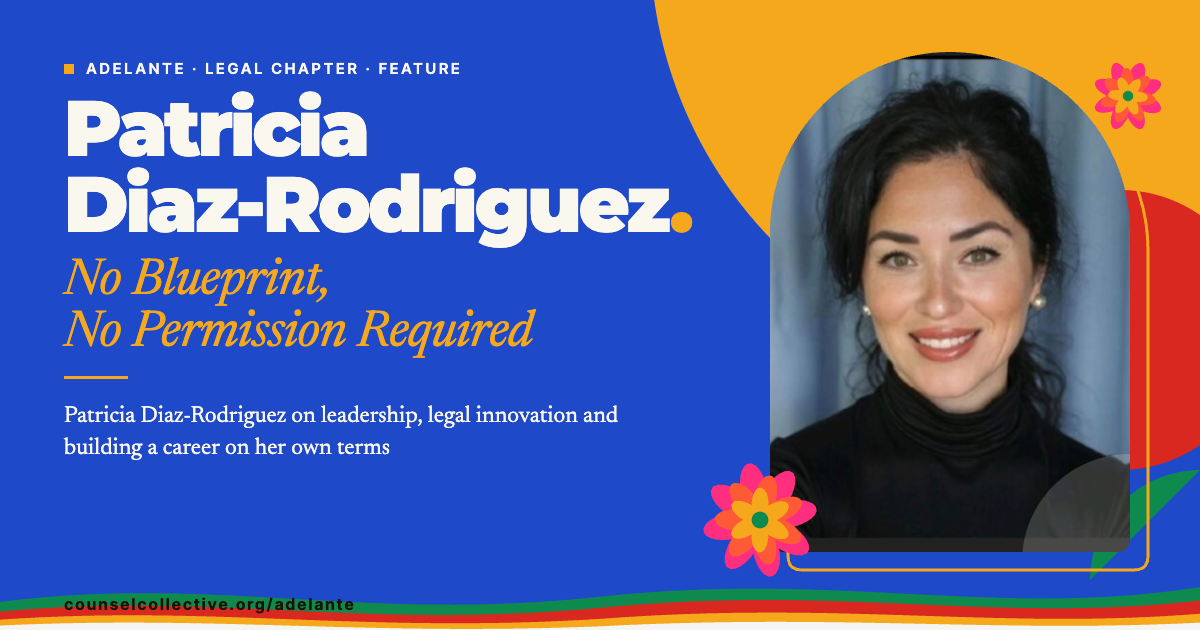
Adelante · Legal chapter · Feature
Patricia
Diaz-Rodriguez No Blueprint,
No Permission Required
Patricia Diaz-Rodriguez is a Director at Consilio whose career sits at the intersection of law, technology and business. She has built a reputation for helping clients navigate complex legal challenges with practical, strategic solutions while building relationships that drive growth and create opportunity.
Legal chapter

Patricia Diaz-Rodriguez on leadership, legal innovation and building a career on her own terms
Christmas Eve is not when most people want a call about document review. For Patricia Diaz-Rodriguez, it was the beginning of a leadership test involving more than 200 people, a regulatory deadline and very little room for error.
In merger review, a second request can demand an enormous volume of information on an unforgiving timetable. Diaz-Rodriguez needed to assemble a review team over the holidays, when almost no one wants to hear the words “document review.”
“A second request landing around Christmas Eve is a pretty good test of leadership and holiday spirit,” she says.
The pressure was obvious. Diaz-Rodriguez knew adding more of it would accomplish little.
“What my team needed from me wasn’t more pressure,” she says. “They needed clarity, decisiveness and someone willing to stay in the trenches with them.”
The team broke the matter into manageable pieces, staffed aggressively, communicated constantly, and addressed problems before they became crises. More than 200 people showed up over the holidays and delivered.
The experience reinforced something Diaz-Rodriguez has carried throughout her career: leadership in difficult moments is rarely about having every answer.
“It’s about creating enough clarity and confidence that a lot of talented people can do something difficult together,” she says. “In high-pressure situations, calm is contagious.”
That ability to bring people, strategy and execution together has become a defining thread in her career.
A Career Without a Blueprint
Today, Diaz-Rodriguez works with corporate legal departments and law firms on complex eDiscovery and litigation matters. On any given day, that can mean assembling technical, project management, review and advisory teams; evaluating technology; developing a pricing strategy; managing risk; or helping a client navigate a matter that has suddenly gone sideways.
She understands not just the legal problems clients face, but the business decisions behind them: budgets, risk, relationships and the value of getting the right people together.
“Being a good lawyer and understanding the work got me into rooms,” she says. “Learning how revenue is created, how relationships become business and how to communicate value helped me stay in them.”
That evolution required letting go of the idea that a legal career had to look a particular way. Her Jordans may not be the expected uniform in every legal meeting, but neither is her career. For Diaz-Rodriguez, professionalism has never required becoming a carbon copy of everyone else in the room.
“I’m a lawyer, but some of my best work has come from stepping outside the traditional boundaries of a legal career into technology, business development and strategy,” she says. “Giving myself permission to color outside those lines changed everything.”
She also learned to say yes before she necessarily felt ready, to raise her hand, introduce herself and build relationships without knowing where they might lead.
“Relationships that felt like coffee at the time became opportunities years later,” she says. “Apparently networking works.”
But the more difficult lesson was learning not to mistake a setback for a verdict.
Her career has included unexpected turns, including some she absolutely did not choose. Rather than allowing one employer, title, or difficult moment to determine her value, Diaz-Rodriguez kept it moving.
“Some of the things that felt most disruptive in real time ultimately pushed me toward bigger opportunities and a much clearer understanding of what I bring to the table.”
Early in her career, Diaz-Rodriguez often found herself in professional settings where few people shared her background. She initially believed credibility meant knowing every answer.
Experience taught her otherwise.
“Leadership is often about asking the better question, admitting what you don’t know, bringing the right people together and then getting something done.”
It also taught her not to be overly constrained by a job description.
“Some of the most important things I’ve done professionally were things nobody technically hired me to do,” she says. “I have never been particularly good at staying in my lane. Thankfully, that turned out to be a career strategy.”
Trust Before Technology
That willingness to challenge conventional thinking is particularly relevant in eDiscovery, where innovation and risk often collide.
Legal professionals are trained to value precedent, certainty and defensibility. New technology, especially artificial intelligence, can challenge all three.
Diaz-Rodriguez understands the tension. Her approach is not to begin with technology. She begins with the problem.
Where is the client spending too much? Where is the legal team losing time? What keeps going wrong? What does the organization need to know sooner?
Only then does the conversation turn to whether a different platform, workflow or AI tool can improve the outcome.
“Innovation without trust is just a very expensive science experiment,” she says.
Sometimes the answer is a new tool. Sometimes it is using an existing one better. And sometimes, Diaz-Rodriguez says, the right recommendation is not to change anything yet.
My job is to help clients move forward without making them feel like the guinea pig.
That philosophy extends beyond AI.
One of the persistent problems Diaz-Rodriguez sees in eDiscovery is the tendency to apply standardized processes to matters that are anything but standard.
A corporation may simultaneously be managing internal investigations, employment disputes, regulatory matters, and large-scale litigation. Expecting the same technology, workflow, and pricing structure to work equally well for all of them makes little sense.
Her approach is to start with the matter itself. What are we trying to accomplish? What is the risk? How quickly do we need answers? How much data are we dealing with?
Then build the solution around those answers.
When it works, the benefit goes far beyond faster review or reduced cost. Clients gain earlier insight, greater visibility into spending and data, and more time to focus on legal strategy rather than managing the mechanics of discovery.
Diaz-Rodriguez jokes that her goal is to make eDiscovery considerably less eventful.
“Fewer surprises, fewer fire drills and fewer invoices that require a follow-up meeting,” she says. “In our world, boring can be a very good outcome.”
The Highlight Reel and the Game Film
Diaz-Rodriguez did not grow up with a professional roadmap or a network of people who could explain how a career like hers was built.
“A lot of what I built, I built by figuring it out as I went: asking questions, taking chances, making mistakes and occasionally Googling things I probably should have already known.”
Through the wrong turns and hard-earned wins, her husband and three children have remained her constant.
“They are my center and my driving force.”
Over time, younger professionals began approaching her for advice, introductions or simply answers to questions they were uncomfortable asking elsewhere.
“I realized I had become something I didn’t have when I was starting out: someone who could make the path feel a little less mysterious.”
That responsibility matters particularly when she thinks about younger Latino professionals looking at established leaders and seeing only the finished product.
The polished bio is the highlight reel, not the game film.
Behind her own résumé, she says, are rejections, wrong turns, layoffs, self-doubt, and plenty of moments when she had no idea what came next.
“Some of the biggest advances in my career came immediately after moments that felt like failures.”
She wants younger professionals to understand that success does not require erasing the parts of themselves that make them different.
“Early in my career, I thought professionalism meant adapting myself to the room,” she says. “Now I think leadership is having the confidence to bring yourself into the room, and knowing you belong there before anyone else confirms it.”
From Representation to Influence
Diaz-Rodriguez’s view of representation has also evolved.
Visibility matters. But visibility alone is not enough.
“Diversity is important, but I’m increasingly interested in who has influence,” she says. “Who owns the client relationship? Who controls revenue? Who is developing the strategy? Who gets to make the call?”
For Diaz-Rodriguez, progress means more than an invitation into important spaces. It means having the authority to shape what happens there.
That also creates a responsibility for those who have already gained access.
“If I’m fortunate enough to be in rooms that were once difficult for me to enter, I should be making introductions, sharing information, advocating for people when they aren’t in the room and being candid about how this all actually works.”
Her version of mentorship is practical: introductions, information, advocacy and candor about the misses.
“Younger Latino professionals deserve to see that part too,” she says, “because you shouldn’t mistake someone else’s polished chapter for evidence that you’re doing your own story wrong.”
What Comes Next
Over the next several years, Diaz-Rodriguez expects AI to reshape legal services. But she is less interested in how many new tools the profession adopts than in whether those tools improve the delivery of legal work.
For her, the measure of progress is not adoption for its own sake. It is whether legal teams make better decisions, work more efficiently, control costs and spend more time on strategy.
Eventually, she believes, the strongest evidence that AI has transformed legal work will be that people stop talking about it as something revolutionary.
“We’ll spend a lot less time talking about how revolutionary AI is and more time saying, ‘Of course we work this way,’” she says. “That’s usually how you know innovation actually worked.”
Her own ambitions follow a similar trajectory. Earlier in her career, much of the work was about earning credibility and gaining access. Today, she is thinking more about what can be done with both.
“I worked hard to get a seat at the table,” she says. “At this point in my career, I’m much more interested in making the table bigger.”