At the Center of the Maelstrom. Jason Fiorillo, Chief Legal Officer at Boston Dynamics, on scaling a legal function as humanoid robots walk out of the lab into policy rooms that haven’t written the rules yet.
Atlas has gone bipedal. Spot is the most recognizable quadruped on the planet. Stretch is lifting boxes in distribution centers. Orbit is managing the fleet. The lab at Waltham is cutting four products at once while the industry is still arguing about what to call them. Fiorillo arrived in 2006 when the company was 180 people and fresh off a DARPA directive to build a robot that could walk. Twenty years later he’s running legal for a 1,000-person engineering shop whose products now travel five kilometers on their own and talk to OSHA inspectors.
This is a field report from the seat where product liability, ESG, trade controls, humanoid robotics policy, and AI regulation all converge on one desk. Read the full dossier below.
Legal leadership in the age of robotics — how Jason Fiorillo navigates AI, policy, and a regulatory framework that has not caught up at Boston Dynamics.
Dossier Metadata
Subject
Jason Fiorillo
Role
Chief Legal Officer
Company
Boston Dynamics
Tenure
2019 → Present
Prior
Analog Devices
Series
The Builders
Filed
2026.04.20
Scroll to begin report
180
Employees at Arrival (2019)
1,000+
Employees Today
04
Product Lines: Spot · Stretch · Orbit · Atlas
2006
EU Machinery Directive
5km
Spot Autonomous Walk Range
2021
Hyundai Acquisition
Jason Fiorillo does not have the luxury of time. At Boston Dynamics, the CLO role has never been about deliberating over what the law says. It has been about making decisions — fast, informed, sometimes imperfect — while the world around him transforms at a rate for which no legal playbook has caught up. The company he joined in 2019 employed 180 people and had yet to field its first commercial product. Today it employs over 1,000, with plans to grow significantly in the coming years. The products that did not exist when he arrived — Spot, Stretch, Orbit and the Atlas humanoid now in limited pilot phase — are reshaping what AI-enabled mobile robots can be and what they can do.
His job has changed accordingly. What began as the work of commercializing an advanced but traditional quadruped robot has evolved into something far more complex: navigating the convergence of AI, government affairs, global standards, and a regulatory environment so outdated that some of the laws he has to work with predate the concept of a walking robot entirely.
Transcript // Fiorillo.JTopic // Operating Tempo
Indecision is the worst decision. In our field, speed is essential for success. If you fail to act, delays caused by indecision stack up to impede progress and adversely impact your goals.
Jason Fiorillo // Chief Legal Officer, Boston Dynamics
01.00
Operating Context
From 180 to 1,000
When Fiorillo joined Boston Dynamics, the company was at an inflection point. Spot was not yet a product — it was a plan. His mandate was to help commercialize it: figure out what standards applied, develop core terms and conditions, ensure safety processes and procedures, and begin selling into markets that had never purchased a walking robot before.
The early adopters were a specific kind of buyer. Academics, universities, celebrities, and organizations with discretionary budgets who wanted to experiment with bleeding-edge technology. Spot was, at the time, “a solution in search of a problem.” The company believed third parties would develop applications for the platform, and many did — while the team continued building toward clearer product-market fit.
Product-market fit arrived through industrial asset management and inspection. Robots that could navigate complex facilities, collect data, and eliminate dangerous or repetitive human tasks proved their return on investment rapidly. Customers paid for their robots. The business began to scale.
SpecSheet // 01.ASource // Subject Interview · Company Disclosures
01.A.1
Headcount at Arrival — 2019
180employees
01.A.2
Headcount Today
1,000+employees
01.A.3
Active Product Lines
4Spot · Stretch · Orbit · Atlas
01.A.4
Controlling Acquisition
2021Hyundai Motor Group
In 2021, Hyundai Motor Group acquired a controlling interest in Boston Dynamics, bringing manufacturing scale, global sales infrastructure, and significant investment capital. The partnership accelerated the company’s ability to grow and compete on a global stage — and managing that growth, both operationally and culturally, has become one of the defining challenges of Fiorillo’s tenure.
Bridging the demands of a rapidly scaling organization while preserving the technical agility that defines Boston Dynamics has been a constant balancing act — one that shapes every decision his team makes.
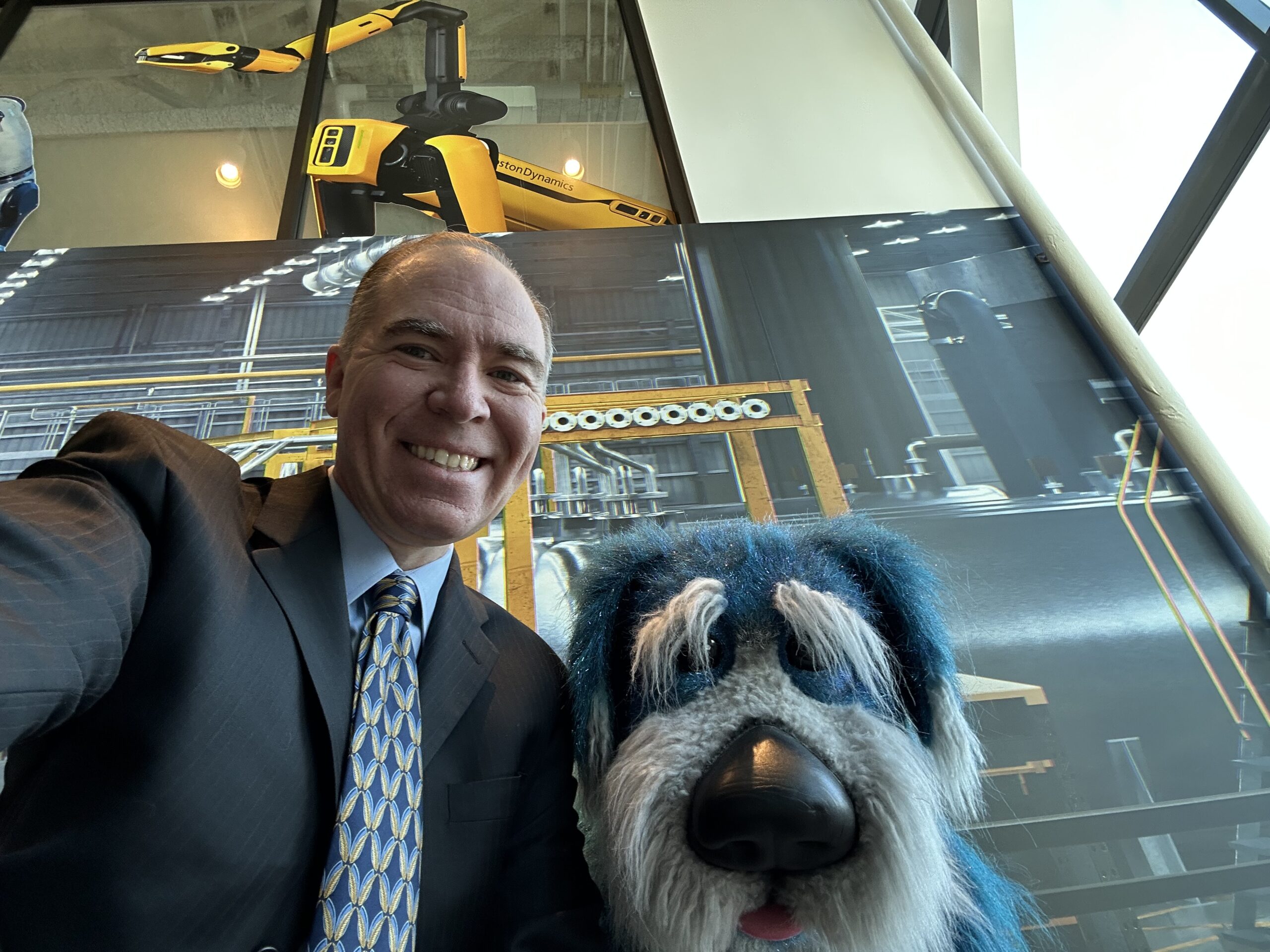
Fiorillo with Spot, the quadruped robot that launched Boston Dynamics’ commercial era, and the company mascot at headquarters. Photo: Courtesy of Jason Fiorillo.
02.00
Decision Pressure
The Poker Table
Before joining Boston Dynamics, Fiorillo spent years leading a legal team at Analog Devices, a well-established semiconductor company in a well-established industry. The pacing was different. He remembers a single agreement that took five years to negotiate. The company’s products demanded high margins, and were designed in to applications that lasted from five to twenty-five years (or more). In that environment, the business could afford to take its time.
At Boston Dynamics, five years might be the lifespan of an entire product category.
The distinction he draws between in-house and outside counsel captures the difference. Outside counsel, he says, is the expert standing behind you at the poker table — analyzing hands, offering perspective, rarely at risk themselves. In-house counsel is the person who has to play a card. With limited information, a fixed budget, and under time pressure, you make a decision and you live with it. Outside counsel can spend 400 hours researching a question. In-house counsel often needs the answer by tomorrow.
Transcript // Fiorillo.JTopic // In-House vs. Outside Counsel
Each decision constitutes, essentially, a wager. I think this is the right answer — and you have to make your wager with limited information, a fixed budget, and of course, time pressure.
Jason Fiorillo // Chief Legal Officer, Boston Dynamics
In his words, his team is “small but mighty.” The legal department at Boston Dynamics punches well above its organizational weight, and Fiorillo is deliberate about how he manages it — investing personally in each team member’s development and maintaining the ability to engage specialist outside counsel where additional depth is needed.
03.00
Regulatory Gap
Where the Law Hasn’t Caught Up
Perhaps no aspect of his work illustrates the challenge more vividly than safety compliance.
The 2006 Machinery Directive in Europe — a regulation designed for industrial robots bolted to factory floors — required robots to utilize an emergency stop fixedly mounted outside a zone of danger, typically within view of the robot. That requirement made perfect sense for a ten-ton arm welding cars on an assembly line. It does not translate to a robot that can walk five kilometers autonomously.
Transcript // Fiorillo.JTopic // Safety Compliance Gap
Where do you put the button? If the button is on the robot and the robot is malfunctioning or flailing wildly, the human who needs to press it is precisely in the wrong place.
Jason Fiorillo // Chief Legal Officer, Boston Dynamics
Plate // 03Subj // Fiorillo + AtlasFrame // 003.A
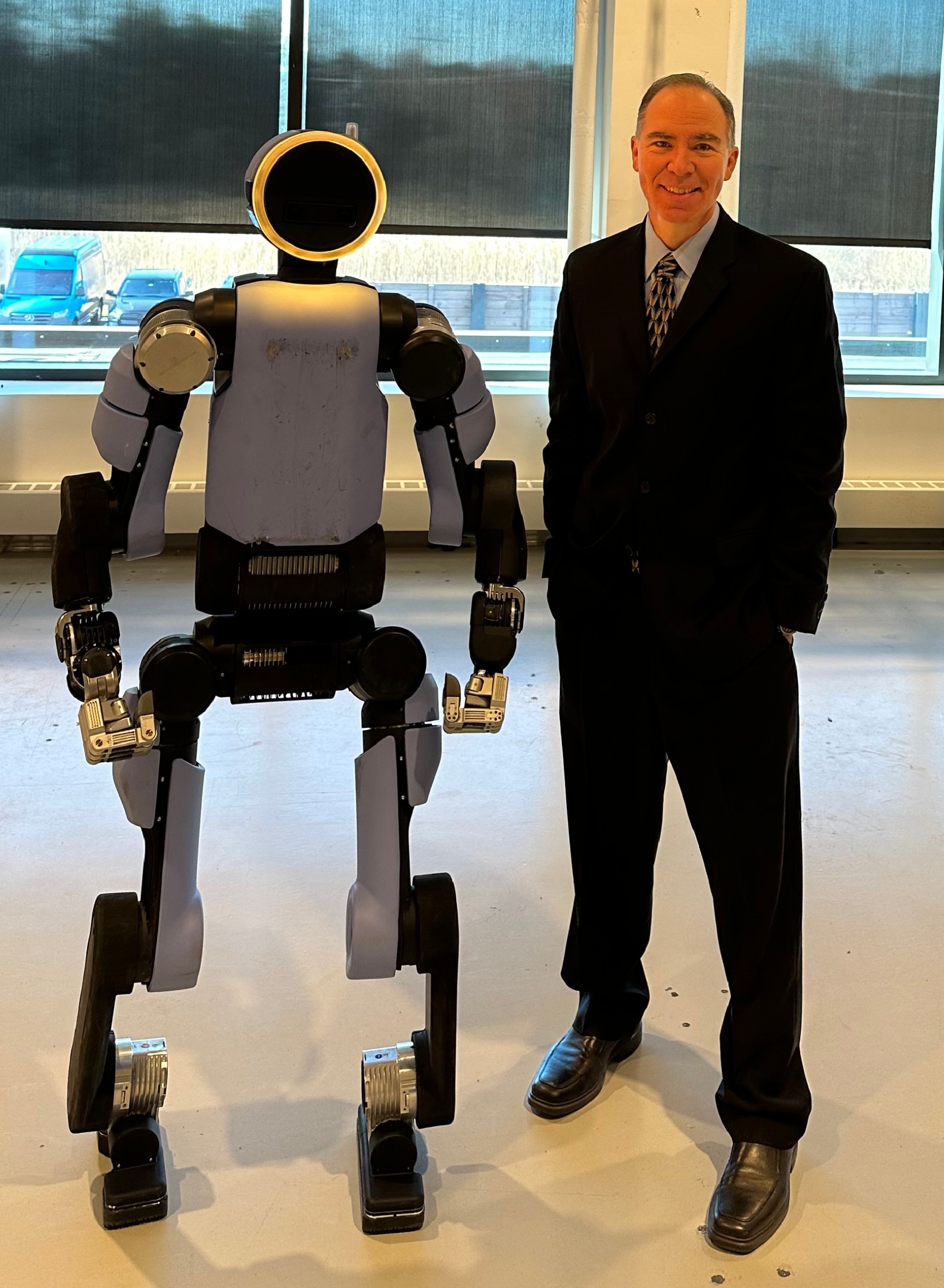
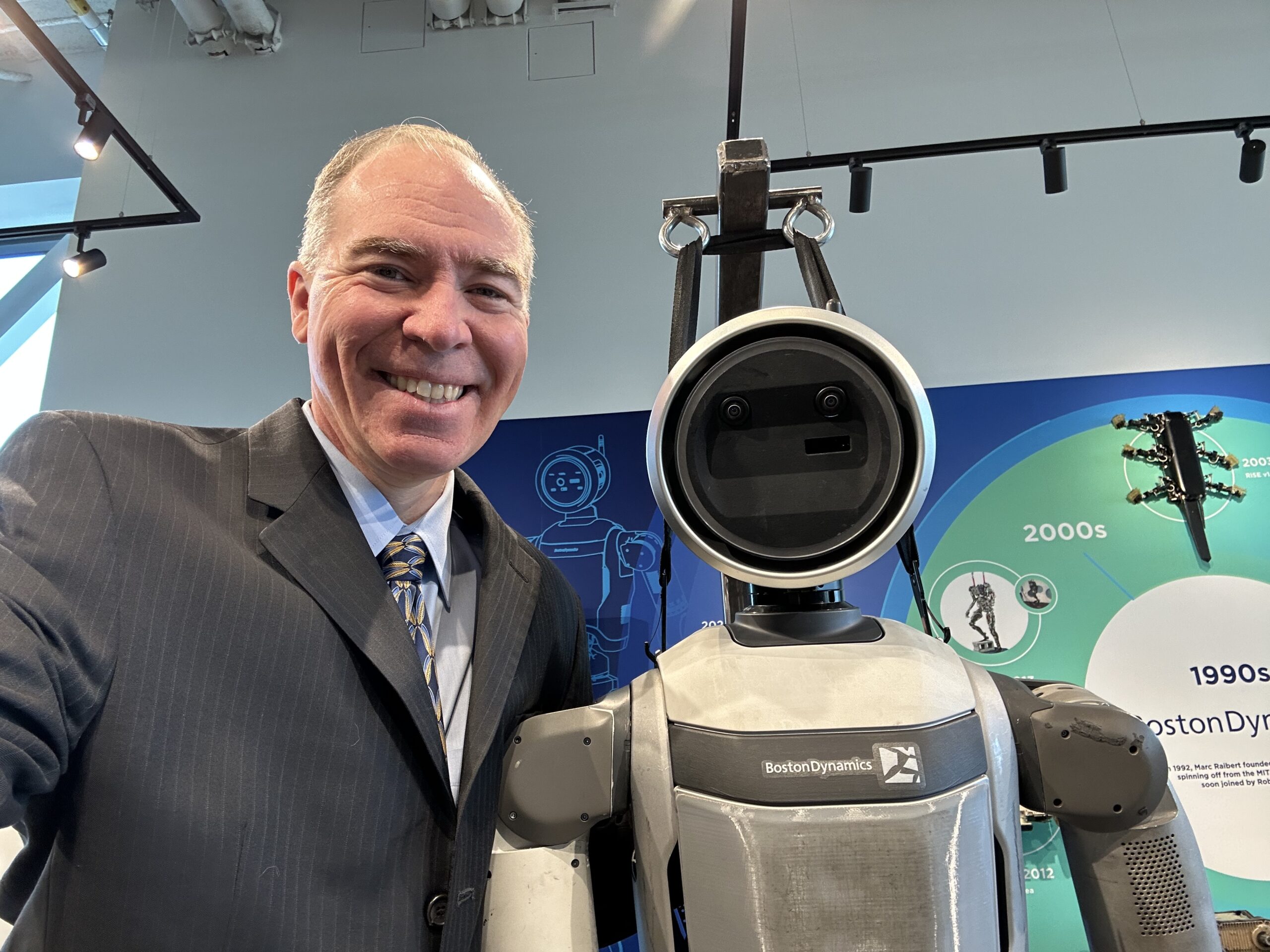
Fiorillo beside the Atlas humanoid robot, with Boston Dynamics’ evolution timeline visible in the background — from the 1990s founding through today’s AI-enabled commercial platforms. Photo: Courtesy of Jason Fiorillo.
If the robot’s entire value proposition is operating autonomously without supervision, then a one-to-one human monitoring relationship defeats the purpose. You might as well just send a person to accomplish the job.
These are not abstract legal questions. They are the daily reality of commercializing technology that the regulatory framework was not designed to contemplate. The questions become philosophical before they become legal: what does “safe” mean? Safe where? To whom? Under what conditions? And how do you operationalize that definition for engineers who need shorthand they can act on?
Fiorillo’s answer: “Would you let someone you love operate this robot when properly trained, in the proper environment, with proper equipment?” If yes, that’s directional. If no, then something needs to be addressed. It is not a legal standard. It is a human one.
04.00
Policy Room
The Industry, in Draft
The macro environment has changed as dramatically as the internal one.
In 2021, Boston Dynamics occupied a singular position: the company behind the only compelling humanoid robot on the planet. Tesla’s “Tesla Bot” was simply a spandex-clad actor. Figure did not exist. Unitree was focused on quadrupeds. In Fiorillo’s words, Boston Dynamics inspired both the public and a cohort of fast followers. Today, the humanoid robotics market is highly competitive, the global race for AI-enabled autonomy is intense, and the policy frameworks that will govern the industry are still being written.
Government attention to robotics has accelerated significantly in recent years, and Fiorillo has been at the table for much of it. He has met personally with a wide cross-section of U.S. federal leadership across agencies including the Departments of Transportation, Commerce, the EPA, and the White House Office of Science and Technology Policy. Each meeting is a variation on the same theme: here is what this technology can do, here is what thoughtful policy looks like, here is what the United States needs to get right to lead the world in this industry.
Transcript // Fiorillo.JTopic // Role Transformation
The whole world has changed dramatically. My role has changed from commercializing a singular quadruped to being in the center of the maelstrom of AI, humanoids, technological standards, and governmental change.
Jason Fiorillo // Chief Legal Officer, Boston Dynamics
For an attorney annealed in semiconductor law who rarely visited the Capitol, it is, he says, a new opportunity. But it is also exactly the work that needs to be done. At this stage, the legal strategies Boston Dynamics develops are not just protecting the company. They are setting precedents for an industry.
05.00 // Field Summary
The advice he would offer anyone considering a legal leadership role in frontier technology is the same advice that governs his work at Boston Dynamics every day:
Jason Fiorillo leads the legal function at Boston Dynamics, where he has steered the company through its transformation from a 180-person R&D lab into a 1,000+ employee commercial robotics leader producing four active product lines — Spot, Stretch, Orbit, and Atlas. He is a frequent participant in U.S. federal policy conversations on AI, autonomy, and robotics standards. Prior to Boston Dynamics, Fiorillo led legal teams at Analog Devices. He is a featured executive in Counsel Collective’s The Builders series.
Tenure
2019 → Present
Prior
Analog Devices
Series
The Builders
Nominations Open
Nominate a Leader
Know someone who belongs on this list? Tell us about them.